
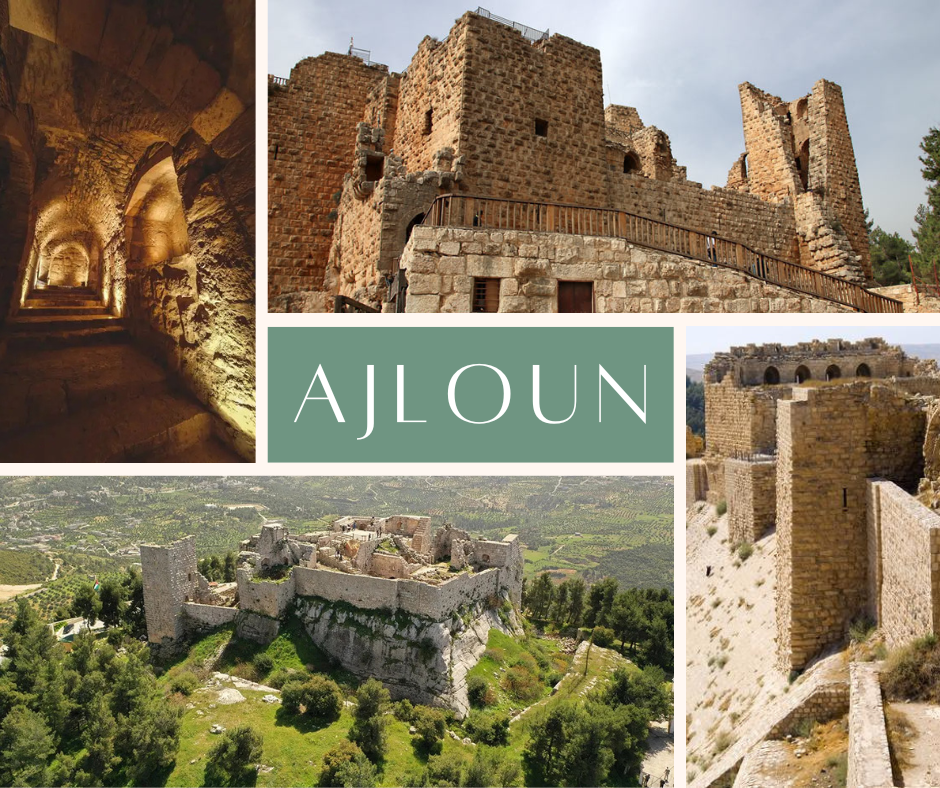
The marvels of nature and the genius of medieval Arab military architecture have given northern Jordan two of the most important ecological and historical attractions in the Middle East: the sprawling pine forests of the Ajloun-Dibbine area, and the towering Ayyubid castle at Ajloun, which helped to defeat the Crusaders eight centuries ago.
Ajloun is located 73 km north of Amman, at the northwest of Jerash. You will enjoy a fascinating road through a beautiful pine-forest and olive palms, until you reach the town of Ajloun. Ajlous is where Hadrian built himself an arch outside the town and stayed over the winter of 129 – 30 AD. Ajloun Castle, more formally known as Qal’at Ar-Rabad, towers above the green hills of Ajloun and can be seen from many miles away, betraying its strategic purpose as a military watch post that protected the trade routes in the 12th-15th centuries. It was first built in 1184 by one of Saladin’s generals, Izzeddin Usama Mungidh, to control the iron mines of Ajloun, and to deter the Franks from invading Ajloun. Ajloun Castle dominated the three main routes leading to the Jordan Valley and protected the trade and commercial routes between Jordan and Syria; it became an important link in the defensive chain against the Crusaders, who, unsuccessfully spent decades trying to capture the castle and the nearby village.The original castle had four towers, arrow slits incorporated into the thick walls, and surrounded by a moat averaging 16 m in width and up to 15 m deep.
In 1215 AD, the Mameluk officer Aibak ibn Abdullah expanded the castle following Usama’s death, by adding a new tower in the southeast corner and a bridge that can still be seen decorated with pigeon reliefs. The castle was conceded in the 13th century to Salah ed-Din Yousef Ibn Ayoub, ruler of Aleppo and Damascus, who restored the northeastern tower. These expansion efforts were interrupted in 1260 AD when Mongol invaders destroyed the castle, but almost immediately, the Mameluk Sultan Baybars re-conquered and rebuilt the fortress.
Ten Salah ed-Din soldiers are guarding the castle every day of the week. They are placed at the four different gate levels that the castle has. Two are on the roof where the yellow Mameluk is flying. Siege ladders leaning on the wall add to the war-like atmosphere. Today, the castle is well-preserved and becomes a famous essential attraction for foreigners and Jordanians as well. The structures, towers, chambers, galleries and staircases makes Ajloun a very special destination. As well as the fascinating landscape, that surrounds the hills will blow your mind for sure.
Nearby is the Ajloun Nature Reserve, a 13 sq. km protected area of outstanding beauty and diverse wildlife. Within the reserve are two nature trails and chalet-style accommodation. The reserve is managed and maintained by the Royal Society for the Conservation of Nature (RSCN).