
Step into the past at the Amman Citadel, where Roman, Byzantine, and Umayyad legacies converge in one breathtaking location.
The Citadel of Amman is a good place to begin a tour of the archaeological sites of the city. It is the site of ancient Rabbath-Ammon and excavations there have revealed numerous Roman, Byzantine and early Islamic remains. Located on a hill, it not only gives visitors a perspective of the city’s incredible history but also provides stunning views of the entire area. Among the most wonderful places you can visit while in Amman, there are some places of specific interest at the Amman Citadel include:
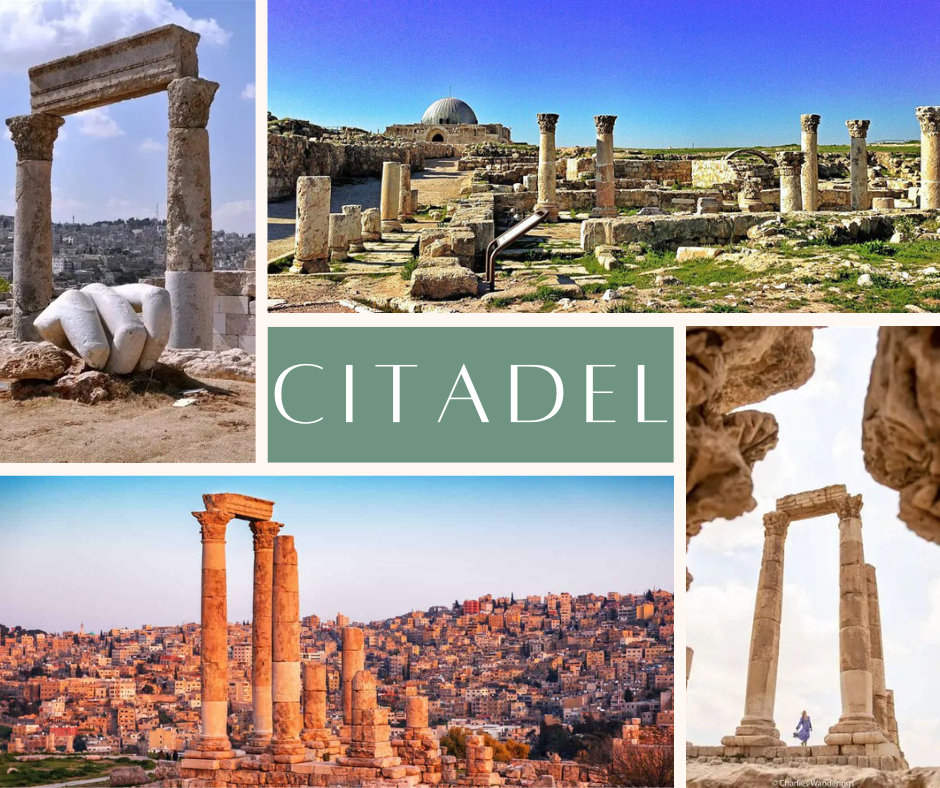
1- The Temple of Hercules, built during the reign of the Emperor Marcus Aurelius (161-180 AD).This great temple was dedicated to a supreme Roman deity. It has been attributed to Hercules due to the discovery of gigantic fragments of a marble statue. Hercules was the son of Zeus and a mortal woman (Alcemene) and was known for his supernatural physical strength. Also, Hercules is depicted on Roman coins minted in the city, which was called Philadelphia at the time.
According to an inscription that was at the top of its facade, the temple of Hercules was built when Geminius Marcianos was governor of Provincia Arabia in dedication to the co-emperors of Rome, Marcus Aurelius and Lucius Verus.
Corinthian capitals supporting a dedicatory inscription, according to which the temple was built when Geminius Marcianos was governor of Provincia Arabia (161 -166 AD) in dedication to the co-emperors of Rome, Marcus Aurelius and Lucius Verus.
2- The Byzantine Church, believed to date from the 6th or 7th century AD. Dating back to approximately 550 AD, this 6th-century Byzantine church is a prime example of early Christian architectural design. Built in a basilical layout, the church features a central nave flanked by two side aisles, a typical structure of religious buildings from this period. At the eastern end, a semi-circular apse is separated from the rest of the church by a chancel screen, marking the sacred space for liturgical ceremonies.
One of the unique aspects of this church is the use of Corinthian capitals, adorned with intricate acanthus leaves, which were repurposed from the nearby Temple of Hercules, showcasing a blend of architectural heritage. The church’s aisles are paved with flagstones, adding to its historical character.
This church is not just a religious monument but also a bridge between the Byzantine and early Islamic periods, reflecting the historical transitions that shaped the region.
3-The Umayyad Palace complex, dating from 720-750 AD. The great monumental gateway with its cruciform shape and four vaulted niches leads to a courtyard and colonnaded street, which runs through the complex with ruined buildings on either side.
The Umayyad Palace, built around 730 AD, was part of a thriving city within the Citadel, primarily housing government officials and those involved in administrative duties. Numerous residential units have been excavated at the site, offering a glimpse into the daily lives and functions of this important political center during the Umayyad period. These structures reflect the palace’s significance as a hub of governance and influence within early Islamic society.