
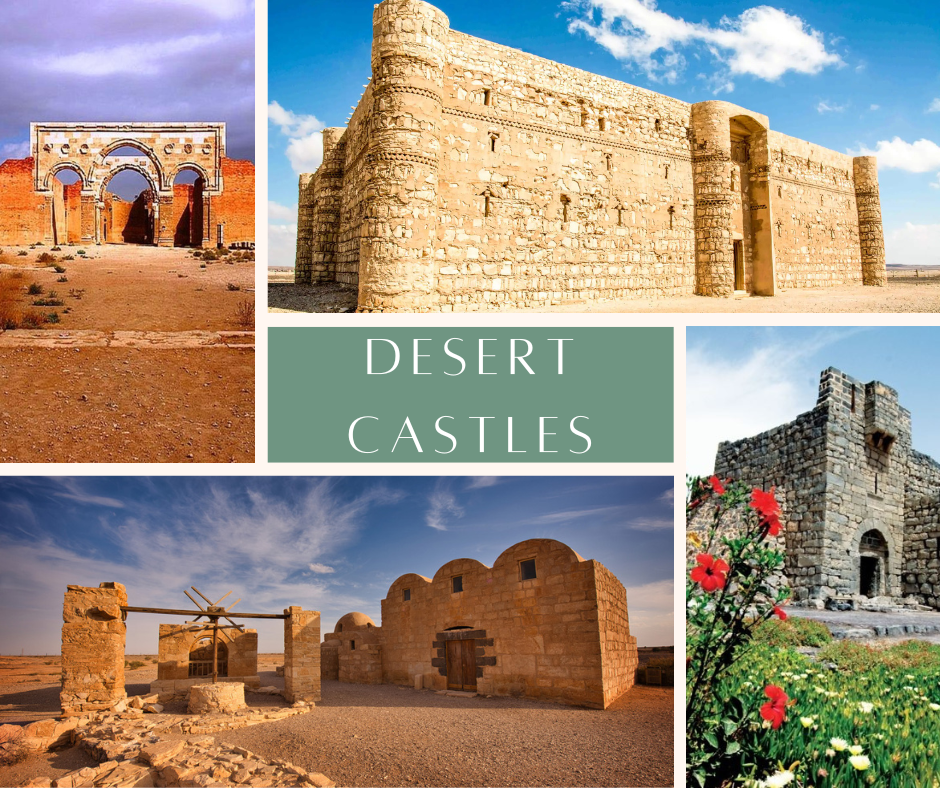
Qasr Al-Mushatta
Qasr Al-Mushatta, often referred to as the Winter Palace, stands as one of the largest and most ambitious Umayyad constructions in Jordan. Located just 30 kilometers south of Amman and a short drive from Queen Alia International Airport, its sheer size and architectural beauty make it a must-visit site. Although it doesn’t sit on the typical Desert Castles route, its extraordinary design, combining Byzantine, Sassanian, and Persian influences, offers visitors a glimpse into the splendors of Islamic architecture.
The craftsmanship suggests the involvement of skilled artisans, potentially from regions as far as Egypt and Iran. Despite its imposing scale, Qasr Al-Mushatta was never completed. However, it was clearly designed on a monumental scale, likely intended to house the entire Umayyad court. The inclusion of a basilica-like throne room highlights its role not just as a residence but as a hub for ceremonial events. It serves as a reminder of the Umayyad dynasty’s architectural prowess and their lasting impact on the Middle East. Additionally, it showcases the interplay between various cultural influences, showcasing how the region served as a melting pot for different artistic styles and techniques.
For visitors, Qasr Al-Mushatta remains an awe-inspiring landmark, even in its unfinished state. After centuries of wear and tear, the structure still stands strong, offering a glimpse into a past filled with elegance, ambition, and artistry.
The palace is a massive square structure, measuring 144 by 144 meters. Its outer walls are punctuated by 25 towers that encircle a central complex of rooms. This central tract includes a mosque, a spacious courtyard, and a throne room, highlighting the palace’s ceremonial grandeur. The placement of the entry hall and mosque on the southern side ensures alignment with Mecca, while the northern section houses the residential area, featuring a distinctive three-bay hall layout.
Qasr al-Azraq
Qasr al-Azraq is a crusader castle situated close to the small town of Azraq. This castle dates back to around 300AD, however; the section of the castle that remains today was constructed in 1237.
Qsar al-Azraq and the town of Azraq are situated in central eastern Jordan, approximately 80 kilometers from the city of Amman. Azraq is located in the Jordanian desert and is the point where three separate deserts join together and continue into Saudi Arabia.
Although it is a notable crusader castle, Qsar al-Azraq was in fact built by the Romans in the 3rd Century AD. Due to its location along the Wadi Sirhan trade route and close proximity to a large lake of water, it was in a convenient position for the Roman military.
Originally constructed from black basalt, Qsar al-Azraq was an important military base during the Byzantine periods and it is thought to have been reconstructed in the early 13th Century. In more recent history the castle was used in World War 1 and was the base for British archaeologist and military officer T.E. Lawrence during 1917 before the final attack on Damascus which resulted in the downfall of the Ottomans.
Qasr Kharaneh
This imposing structure is situated about 65 km east of Amman and 18 km west of Qusayr Amra. Kharaneh is one of the best-preserved Umayyad monuments in the Jordanian steppe. It consists of 61 rooms arranged into 2 levels surrounded by a porticoes central courtyard. These rooms are grouped as self-contained units (bayts), each consisting of a central hall flanked on 2 sides by a pair of rooms opening onto the central hall.
A 3-quarter round buttress supports each of the 4 corners, and 2 quarter-round towers line the entrance in the middle of the south side, whereas half-round buttresses occupy the middle of the 3 remaining sides.
The exterior walls are pierced by narrow openings for lighting and ventilation, not arrow slits as sometimes described. On either side of the passageway that leads to the central court, is a long room, which served as a stable and storeroom. Originally, a small water tank stood in the middle of the courtyard to collect rainwater from the rooftops. Additional water was obtained from seep-holes dug in the adjacent valley-bed.
The construction and architectural technique betray Sassanian influences, such as the use of squinches and shallow vaults resting on transverse arches, in addition to carved stucco decorations.
Qasr Amra
Situated 85 km to the east of Amman, is the little palace (Qusayr) of Amra, noted for its extensive fresco paintings which cover virtually all the interior surfaces. The building is actually the remnant of a larger complex that included an actual castle, meant as a royal retreat, without any military function, of which only the foundation remains. What stands today is a small country cabin. It is most notable for the frescoes that remain mainly on the ceilings inside, which depict, among others, a group of rulers, hunting scenes, dancing scenes containing naked women, working craftsmen, the recently discovered “cycle of Jonah”, and, above one bath chamber, the first known representation of heaven on a hemispherical surface, where the mirror-image of the constellations is accompanied by the figures of the zodiac. This has led to the designation of Qusayr ‘Amra as a UNESCO World Heritage Site. The bathhouse is also, along with examples in the other desert castles of Jordan, one of the oldest surviving remains of a hammam in the historic Muslim world.
That status, and its location along Jordan’s major east–west highway, relatively close to Amman, have made it a frequent tourist destination.
It should be noted that Qusayr Amra was not residential in character, nor was it intended to be occupied over an extended period of time.