
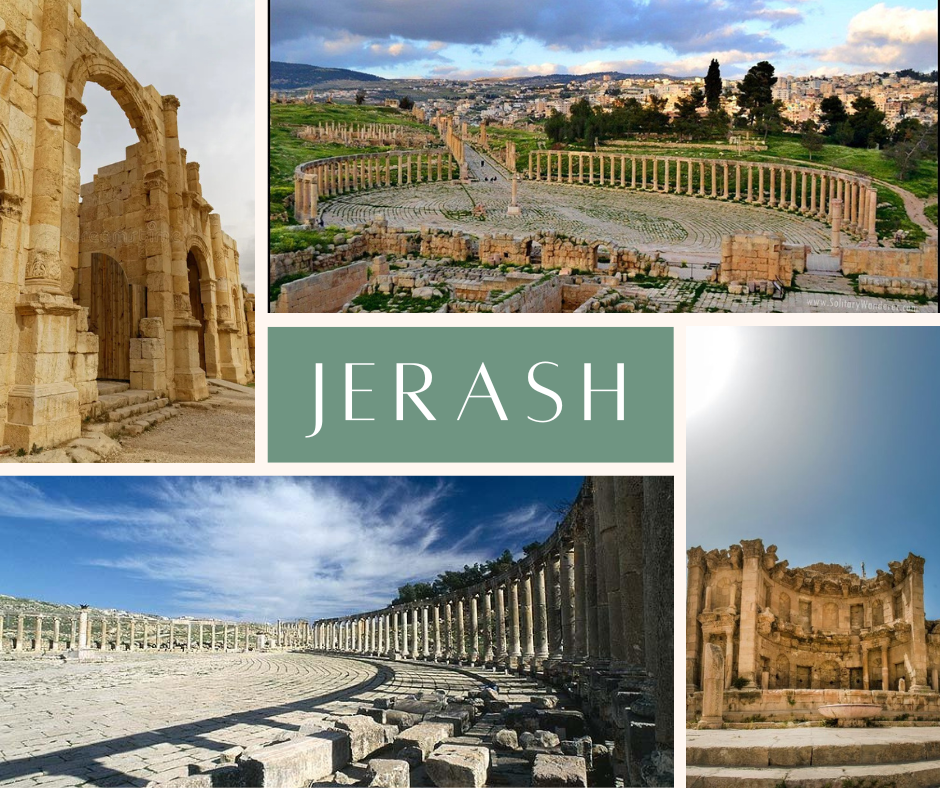
A close second to Petra on the list of favorite destinations in Jordan, the ancient city of Jerash boasts an unbroken chain of human occupation dating back more than 6,500 years and is only about 45km north of Amman and because of its water the site has been settled at least since Neolithic times. The city’s golden age came under Roman rule and the site is now generally acknowledged to be one of the best-preserved Roman provincial towns in the world and one of the Decapolis cities once named Gerasa. Hidden for centuries in sand before being excavated and restored over the past 70 years, Jerash reveals a fine example of the grand, formal provincial Roman urbanism that is found throughout the Middle East, comprising paved and colonnaded streets, soaring hilltop temples, grand theatres, spacious public squares and plazas, baths, fountains and city walls pierced by towers and gates. Beneath its external Graeco-Roman veneer, Jerash also preserves a subtle blend of east and west. Its architecture, religion and languages reflect a process by which two powerful cultures meshed and coexisted – The Graeco-Roman world of the Mediterranean basin and the ancient traditions of the Arab Orient.
The history of Jerash is a long and detailed one that is best discovered whilst exploring the ruins and museums of the city itself. The city was conquered by General Pompey in 64 BC when it was named Gerasa. Gerasa grew in wealth and later became a colony in the third century. Due to an earthquake and a number of crusades leading up to the 12th Century, the city’s ancient sites were not discovered again until the end of the 19th century.
Although the sheer number of statues, plazas, and museums can seem daunting, the ancient Roman ruins of Jerash are very easy to navigate. Once in the old town, visitors can easily navigate their way past each site. A great starting point is Hadrian’s Arch which was built in 129 AD to greet Emperor Hadrian during his visit. From this point you will find the remains of the Hippodrome; a former sporting arena that now holds chariot races to recapture the imaginations of visitors.
Another notable site is the 3,000 seat South Theatre which is still used today for productions and concerts. The Forum is a spellbinding oval structure made of 56 pillars and is an ideal location for budding photographers. For an insight into the huge excavation project that took place in the city, visit Jerash Archaeological Museum which is home to a vast number of fascinating artifacts.