
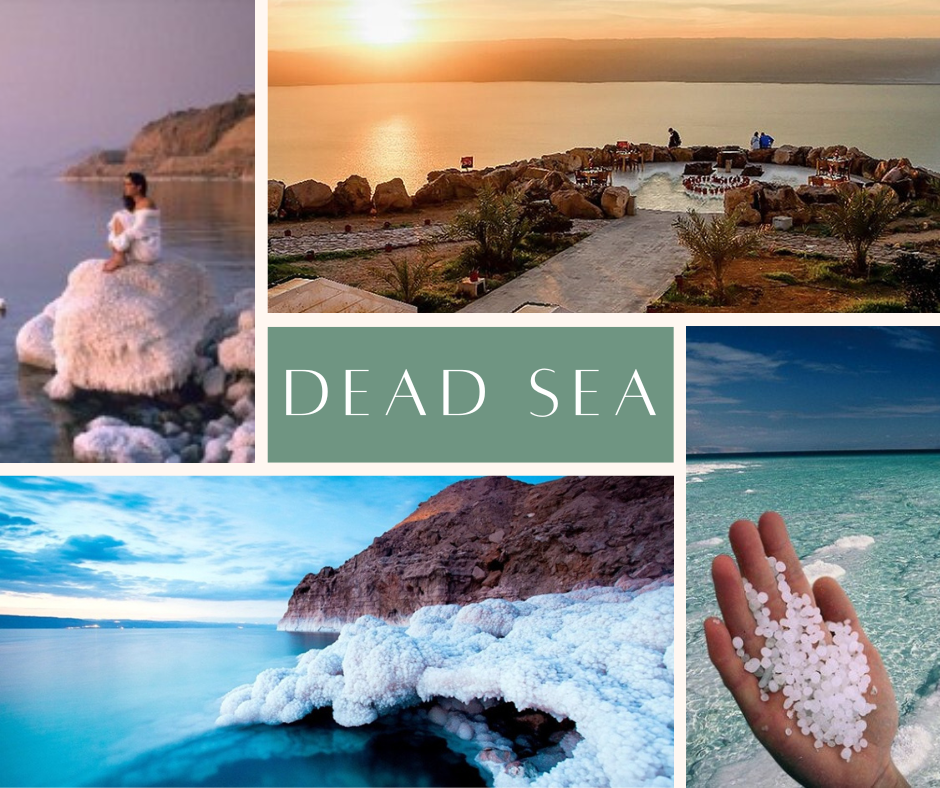
A spectacular natural wonder, the Dead Sea, located 427 meters below sea level, is perfect for wellness tourism and family fun in the sun. The leading attraction at the Dead Sea is the warm, soothing, super salty water itself – some ten times saltier than sea water, and rich in chloride salts of magnesium, sodium, potassium, bromine, and several others. Additionally, the atmospheric oxygen concentration at the Dead Sea is higher than in most other places on Earth, contributing to its health benefits.
During most days, the water shimmers under a beating sun. Where rocks meet its lapping edges, they become snow-like, covered with a thick, gleaming white deposit that gives the area a strange and surreal sense. As its name evokes, the Dead Sea Jordan is devoid of life due to an extremely high content of salts and minerals which gives its waters the renowned curative powers, therapeutic qualities, and its buoyancy, recognized since the days of Herod the Great, more than 2000 years ago.
And because the salt content is four times that of most world’s oceans, you can float in the Dead Sea Jordan without even trying, which makes swimming here a truly unique experience not to be missed: here is the only place in the world where you can recline on the water to read a newspaper.
The area has a historical and spiritual legacy of its own. It is believed to be the site of five biblical cities: Sodom, Gomorrah, Admah, Zebouin and Zoar.
In addition to being an attraction for leisure and medicinal tourism, the Dead Sea Jordan was the location for a number of significant biblical events. The Bible refers to it as the Sea of the Araba, the Salt Sea, and the Eastern Sea (Deuteronomy 3: 17; Joshua 3: 16; Numbers 34: 12; Ezekiel 47: 18).
The Arabah desert, or “wilderness”, of the Bible is the arid basin between the Dead Sea Jordan and the Gulf of Aqaba today known as Wadi Araba.
Of particular importance is the wide plain along Jordan’s southeast Dead Sea Jordan coast known today as the Southern Ghor. Known in the Bible as the Valley of Salt” undoubtedly because of the natural salt formations which form along the water’s edge” it is where David “slew 18,000 Edomites” (2 Samuel 7:29).
This wide plain is also where Abraham and Lot divided their herds and people, going their separate ways after the journey from Egypt.
While Abraham journeyed into Canaan, “Lot chose for himself the whole plain of the Jordan and set out toward the east” (Genesis 13: 11).The Bible then says that “Lot lived among the cities of the plain and pitched his tents near Sodom” (Genesis 13: 12). The Southern Ghor may thus be associated with one of the most dramatic stories in the Bible, that of Sodom and Gomorrah.
While conclusive proof has not yet been found, some scholars see Bab al-Dhra’ and Numeira as good candidates for the biblical Sodom and Gomorrah, destroyed by God because of their wickedness (Genesis 19).
The other biblical “cities of the plain”, Admah, Zeboiim and Bela (or Zoar) may still be waiting to be rediscovered under the ruins of Early Bronze Age towns as Feifa, Safi, Khneizirah, and other places throughout the biblical Valley of Salt.